AI hasn't replaced our developers — it's made them faster, sharper, and more focused on the work that actually moves your project forward. At Workplace Engineering, tools like Claude have quietly become part of how our team designs, builds, and ships solutions. Here's an honest look at where AI fits into our process, and the real outcomes it helps us deliver for clients.
How we actually use AI on a build
The hype around AI tends to skip the practical part: where does it help, and where does human judgment still run the show? For us, AI is a force multiplier across the full lifecycle of a project — discovery, design, development, migration, and documentation — but every line of code and every architectural decision is still reviewed and owned by an experienced engineer. The result is faster turnaround without cutting the corners that matter.
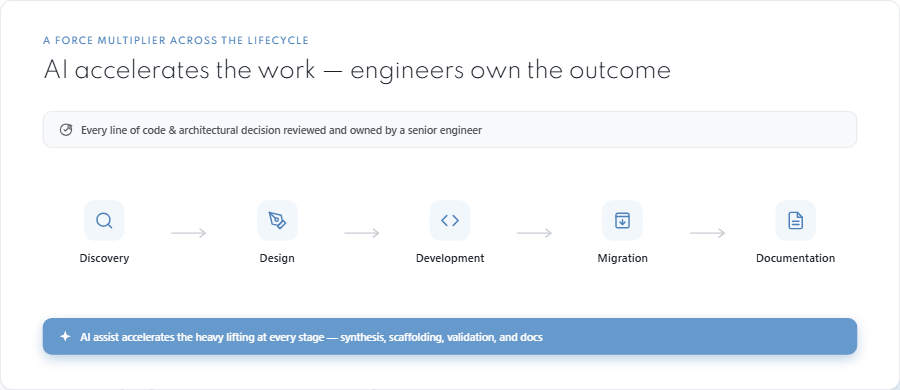
A few places it earns its keep on nearly every engagement:
- Turning messy requirements into clear specs. Clients usually arrive with spreadsheets, email threads, and "here's roughly what we need." AI helps us rapidly synthesize that into structured requirements and data models we can validate with you before we build.
- Accelerating the heavy lifting in code. Boilerplate, integration scaffolding, data-mapping logic, and test cases come together in a fraction of the time, so our developers spend their hours on the tricky business logic unique to your operation.
- Debugging and untangling third-party APIs. When a vendor changes an API or an integration breaks, AI helps us diagnose and adapt quickly instead of burning days reverse-engineering someone else's documentation.
- Documentation that doesn't lag behind. Migration summaries, runbooks, and handoff docs get written alongside the work, not weeks later.
Use cases: AI in real client work
The best way to show the value is through the work itself. Each of the following reflects a real Workplace Engineering project. Details are anonymized, but the outcomes are not.
1. Automating accounts payable for a manufacturer
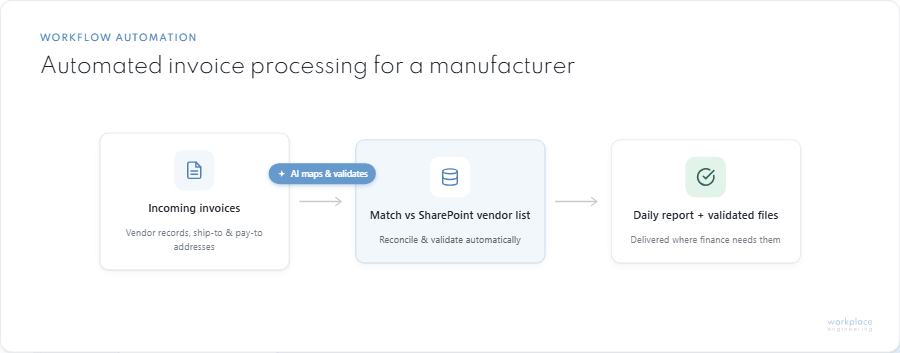
A manufacturing client was drowning in manual invoice processing — matching vendor records, reconciling ship-to and pay-to addresses, and re-keying data between systems. We built an automated pipeline that reads incoming invoices against a SharePoint-hosted vendor reference, generates a clean daily report, and drops the validated files where the finance team needs them. AI accelerated the data-mapping and validation logic, letting us stand up a working solution quickly and iterate with the client in near real time. The payoff: hours of manual reconciliation replaced by a process that runs on its own every day.
2. Connecting purchase-to-pay across disconnected platforms
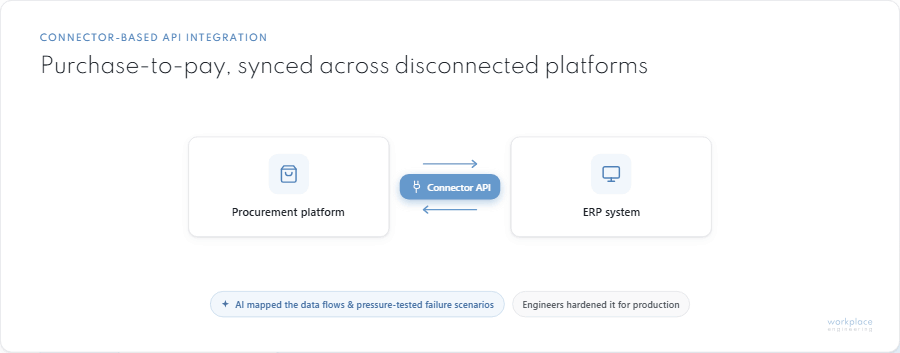
Another client needed their procurement platform to talk to their ERP system so purchase-to-pay data would sync without anyone copying it by hand. The challenge was a connector-based API integration with plenty of edge cases. We used AI to map the data flows, draft the integration logic, and pressure-test the failure scenarios — then our engineers hardened it for production. The two systems now stay in sync automatically, removing a recurring source of errors and delay.
3. A modern intranet for a multi-company organization
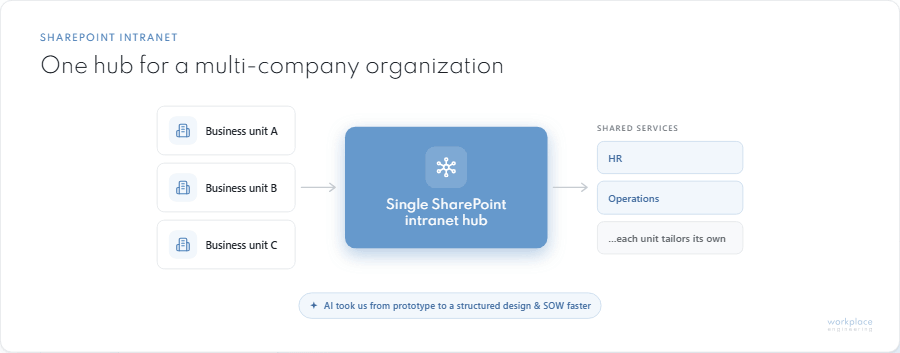
A client operating several business units under one roof wanted a single SharePoint intranet with shared services — HR, operations, and more — that each company could still tailor. AI helped us move from prototype to a structured design and statement of work faster, exploring layout and information-architecture options so the client could react to something concrete instead of a blank page. We compressed the discovery cycle and got to a build-ready plan sooner.
4. Replacing spreadsheet chaos for a construction management firm
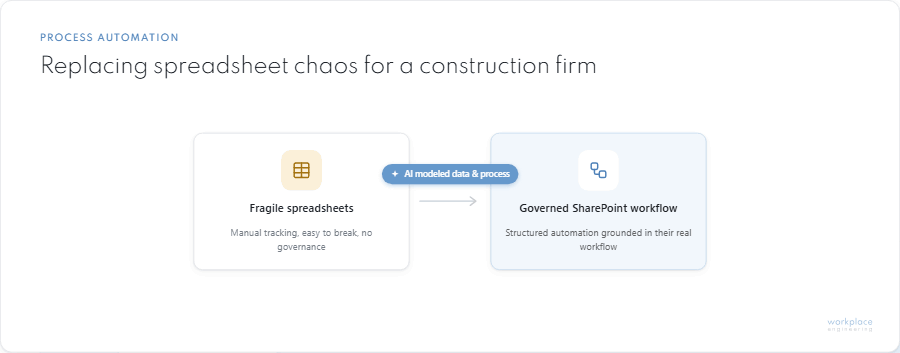
A project-and-construction-management firm was running critical workflows out of fragile spreadsheets. We designed a SharePoint solution with structured workflow automation to replace the manual tracking. AI supported the discovery phase — quickly modeling how their existing data and processes could map into a governed system — which meant our proposed solution was grounded in their actual workflow from day one, not a generic template.
5. A complex platform migration, delivered with less risk
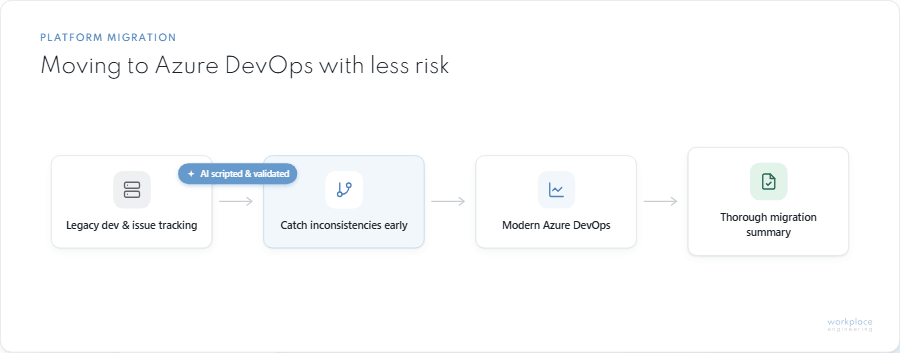
One engagement involved migrating a client off legacy development and issue-tracking systems onto a modern Azure DevOps environment — a large effort with a lot of data and history to preserve. AI helped us script and validate the migration, catch inconsistencies early, and produce a thorough migration summary so the client's team understood exactly what moved and how. A migration that could have dragged on was completed cleanly, with documentation the client could actually use.
6. Eliminating scheduling conflicts for an events team
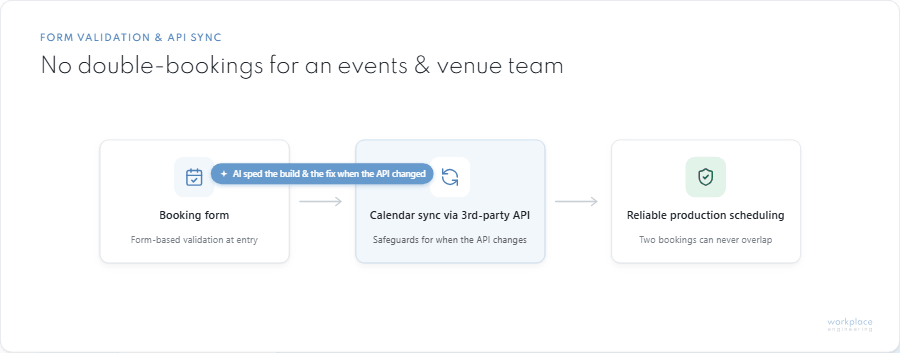
An events and venue client needed to guarantee that two bookings could never quietly overlap. We built form-based validation and calendar synchronization through a third-party API, with safeguards for when that API changed underneath us. AI sped up both the original build and the rapid diagnosis when the vendor pushed a breaking update — keeping the client's production scheduling reliable.
Why this matters for your project
The thread running through all of these is the same: AI lets a senior team deliver more, faster, without trading away quality or accountability. We're not handing your project to a chatbot. We're using the best available tools to spend less time on the repetitive parts and more time on the decisions that determine whether a solution actually fits your business.
For you, that translates into shorter discovery cycles, quicker prototypes to react to, fewer surprises during integration and migration, and documentation that's ready when you need it — all backed by engineers who own the outcome.
Thinking about a build, an integration, or a migration? Let's talk about what's possible. We'll show you exactly how we'd approach it — AI included.
About the author
Matthew Koon leads solution delivery at Workplace Engineering, where the team builds custom SharePoint, Power Platform, and .NET solutions for clients across manufacturing, professional services, construction, and beyond. He focuses on pairing senior engineering with modern tooling to ship dependable software faster.